

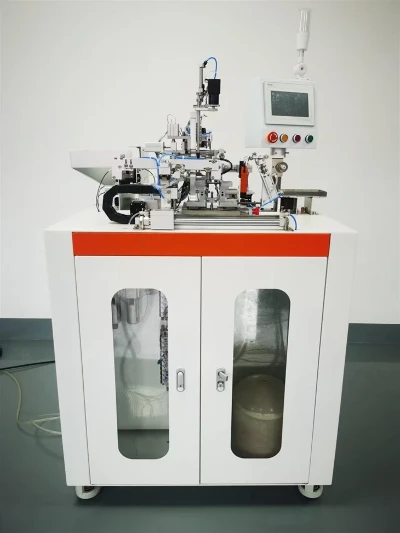


Fully Automatic Coil Winding Machine:Unleashing Efficiency and Precision
1. High-Velocity Throughput Optimization
In industrial coil fabrication, the transition from manual or semi-automated processes to fully autonomous systems represents a paradigm shift in cycle time efficiency. Traditional methods are inherently limited by human intervention, requiring manual wire positioning and constant adjustment, which fluctuates based on operator fatigue and skill. Conversely, the autonomous winder utilizes high-dynamic motors and advanced logic controllers to achieve multi-fold increases in output. In small-form-factor electronics, for instance, throughput can escalate from a manual average of 50 units to upwards of 500 units per hour. This is achieved through intelligent algorithms that minimize idle intervals and maintain peak mechanical velocity throughout the winding trajectory.

2. State-of-the-Art Precision and Quality Assurance
Precision is the fundamental metric for high-tier coil production. While manual winding is prone to inconsistencies in tension and pitch, autonomous systems employ high-resolution servo motors to govern the rotation and axial movement of the spindle with sub-micron accuracy. In high-frequency applications, the system can maintain a winding pitch tolerance within $\pm0.01mm$. Integrated sensors facilitate real-time telemetry, monitoring tension and turn-counts to initiate immediate corrective adjustments. This ensures uniform electromagnetic properties, which is critical for optimizing inductance stability in transformers and enhancing power density in electric vehicle (EV) propulsion systems.
3. Multi-Industry Adaptability and Geometric Versatility
The apparatus demonstrates exceptional flexibility across a broad spectrum of technical specifications. Through a programmable command architecture, operators can rapidly reconfigure the system to accommodate diverse dimensions-ranging from sub-millimeter smartphone antenna components to large-scale power grid inductors. The modular wire-feeding assembly is compatible with various conductive materials, including standard copper, aluminum alloys, and specialized aerospace-grade filaments. This universal compatibility allows manufacturers to consolidate multiple production lines onto a single equipment platform, significantly reducing capital expenditure on specialized tooling.
4. Labor Rationalization and Operational Cost Reduction
Automation significantly mitigates the physical demands and repetitive strain associated with traditional winding tasks. By shifting from manual guidance to autonomous execution, the system permits a single technician to oversee a production cell of up to 10 machines simultaneously. This scalability leads to a drastic reduction in per-unit labor costs. Furthermore, the self-diagnostic and monitoring capabilities minimize the "scrap rate" by detecting deviations before they result in defective parts, thereby optimizing material utilization and eliminating the overhead associated with manual rework.
5. Intelligent HMI and Simplified Maintenance Protocols
The equipment features a sophisticated Human-Machine Interface (HMI) with an intuitive touch-screen console, allowing for rapid parameter entry without advanced programming expertise. Integrated self-diagnostic routines continuously scan for anomalies-such as wire breakage or thermal spikes-and provide granular error reporting to minimize downtime. From a service perspective, the machine utilizes a modular design philosophy; critical components can be swapped as discrete units, reducing repair intervals from hours to minutes. Regular preventive maintenance is streamlined through accessible lubrication points and debris-resistant housing.
6. Future-Proof Manufacturing and IoT Integration
As the industry moves toward "Smart Factory" ecosystems, autonomous winders are evolving to include AI-driven process optimization and IoT connectivity. Future iterations will leverage machine learning to analyze performance data in real-time, further refining winding profiles for emerging sectors like quantum computing and advanced avionics. Within an Industry 4.0 framework, these machines function as networked nodes, communicating directly with downstream quality-control systems and upstream logistics to ensure a seamless, data-driven manufacturing pipeline.


