

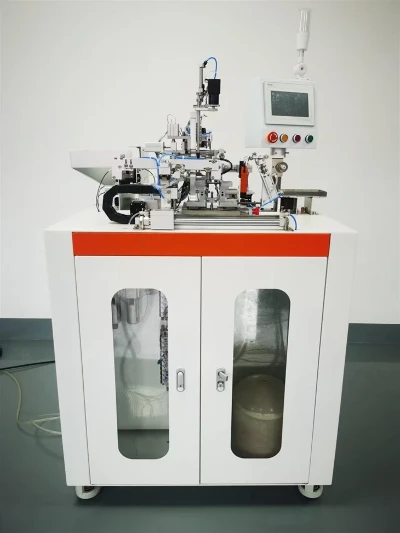


Ceiling Fan Cnc Winding Machine : Redefining Coil Production for Superior Fans
1. Optimized Production Throughput and Cycle Efficiency
The winding assembly serves as the functional "nucleus" of a ceiling fan motor, determining energy metrics and mechanical longevity. This specialized CNC platform addresses the complexities of stator winding-such as multi-layer configurations and precise turn counts-through automated numerical logic. By eliminating manual intervention, the system achieves a 50% to 80% increase in output. A standard stator cycle is reduced from a 120-second manual process to a 40-second automated sequence, allowing manufacturers to scale production rapidly in response to high-volume market demands.
2. Micron-Grade Precision for Enhanced Acoustics and Efficiency
The operational silence and power consumption of a ceiling fan are direct results of coil uniformity. Utilizing high-resolution servo motors and integrated optical sensors, this CNC system maintains turn-count tolerances within $\pm1$ turn and lateral wire placement within a $0.1mm$ deviation. This exacting precision minimizes copper loss and stabilizes the magnetic field distribution, enabling motors to meet Grade 1 energy standards more consistently (a 15%–20% reduction in power draw). Furthermore, the structural stability of the wound coil limits harmonic vibration, sustaining noise levels at or below 30dB for superior user comfort.
3. Universal Compatibility and Rapid Reconfiguration
To accommodate the diverse dimensions of residential (36"–52") and industrial fan stators, the equipment features a highly flexible control architecture. The onboard memory supports the retention of hundreds of distinct winding profiles, allowing for instantaneous retrieval of parameters for varying inner/outer diameters and wire gauges. Transitioning between product specifications is achieved through a modular fixture swap and software selection, a process requiring less than 5 minutes. This versatility facilitates an economical "small-batch, high-variety" production model, maximizing equipment utility.
4. Labor Rationalization and Quality Stabilization
The system mitigates the industry's reliance on high-skill manual labor, which is traditionally prone to fatigue-induced errors and high training overhead. By automating the entire cycle-from conductor feeding to terminal shaping-the CNC unit allows a single technician to manage a multi-machine cell (3–5 units). This transition yields significant annual reductions in labor expenditure while ensuring that product quality remains constant across 24-hour duty cycles, free from the variability associated with human factors.
5. Intelligent Telemetry and Modular Maintenance
Equipped with an advanced Human-Machine Interface (HMI), the system provides a visual environment for parameter calibration and real-time process monitoring. Beyond ease of use, the controller integrates comprehensive data logging for yield analysis and OEE (Overall Equipment Effectiveness) tracking. The hardware utilizes a modular design philosophy, featuring dedicated access ports for the winding head and servo assemblies. In the event of a deviation, integrated self-diagnostic protocols pinpoint the fault location, accelerating corrective maintenance and reducing technical downtime.
6. Regulatory Compliance and Global Market Integration
Adherence to international energy and safety benchmarks (such as the EU's ERP Directive or GB standards) is essential for market tier expansion. The CNC winder ensures that every stator meets stringent electrical and mechanical specifications, eliminating the quality risks inherent in manual fabrication. For export-oriented enterprises, this precision acts as a critical safeguard against non-compliance, facilitating entry into high-standard international markets and reinforcing brand reputation through consistent product excellence.


