

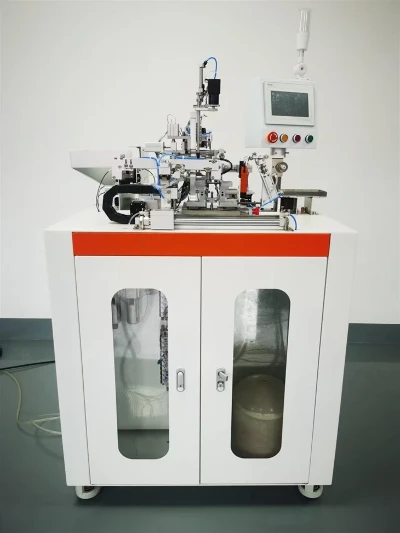


Product Overview & Description
The KXY-860 Fully Automatic Flat Wire Round Hole Winding Machine is an industrial-grade, multi-station manufacturing system engineered for the heavy-duty processing of large-cross-section vertical-wound coils and flat wire magnetic assemblies. Powered by a high-torque, computer-controlled servo drive network, this heavy platform automates the complex bending and layer-forming sequences required to manipulate heavy-gauge flat conductors without damaging the outer insulation wrap.
The mechanical architecture features an independent dual-head workstation configuration designed to expand processing capabilities while simplifying setup profiles. Each head can be independently adjusted via front-to-back fine-tuning axes, enabling fast, toolless mandrel changeovers and drastically reducing material waste during calibration steps. Built into an expansive, heavy-duty framework weighing 1,650 kg, the KXY-860 can process flat wire cross-sections up to 30 mm² and execute complex continuous inner circular profiles-such as specialized A, E2, D, and K tap configurations. This provides power electronics manufacturers with a high-throughput, automated solution that maximizes coil packing density, ensures consistent layer tension, and accelerates large-scale inductor and transformer coil production.
Specification
|
Winding Diameter |
Standard: Wire diameter ≤30 mm², width-to-thickness ratio ≤15 times The wire has a maximum width of 15 mm and a maximum thickness of 2.5 mm. |
|
Maximum Height of Coil |
105 millimeters |
|
Going |
11kW transformer with three-phase 380V input and 220V output |
|
Working Air Pressure |
0.4~0.8mpa/cm |
|
Feed Line Method |
Artificial extraction |
|
Maximum Winding Number |
100T (left and right rotation) |
|
Shape of Product |
A〔Tap〕, E2〔Tap〕, D〔Tap〕, K〔Tap〕, single-layer, multi-layer continuous inner circular coil |
|
Production Efficiency |
0~55pcs/min |
|
Machine dimensions (length*width*height) |
Approximately 9400*1500*2000 mm in dimensions, with a weight of about 1650 kg. |
Producing styles: Flat line round hole winding form

Installation Size

Precautions and Maintenance of Controller
1. Precautions:
① It is strictly prohibited to strike or collide with the motor top or computer screen in any manner.
②. Before powering on, verify the power supply is correct.
③. Lubricate the rotating and sliding parts with engine oil.
④. It is strictly prohibited for any body parts (clothing, scraps of fabric) or tools to come into contact with the rotating parts of the machine.
2. Machine Adjustment Steps:
①. Confirm the product shape and prepare the required nozzle and wire pass nozzle according to specifications.
②. Power on. After the screen is activated, in single, Z-axis, or manual mode, gently turn the handwheel to raise the Z-axis to a higher position, then press the reset button. Wait for the machine to automatically reset before proceeding to the next step.
③. thread the wire, adjust the height of the wire pressing triangle and the center offset between the wire groove seat and the wire diameter and winding direction, and install the nozzle.
④. Select the appropriate slide table based on the product's forming sequence, configure the forming jig, and edit the program (refer to the program editing section for programming mode).
⑤. For the second leg, select the appropriate forming jig based on its shape.
⑥. For the first foot, select the appropriate forming jig based on its shape.
3. Cylinder Adjustment:
①. When the nozzle is reset to zero position, the wire feeder completes its feeding operation. As the nozzle begins to rotate, the wire pressing cylinder immediately withdraws (lifting) the coil after winding, then promptly lowers it (the subsequent cylinder timing is determined based on the part's shape).
4. Tin Furnace Temperature Control:
①. The temperature of lead-tin furnace is generally controlled at 280℃±10℃.
②. The temperature of lead-free tin furnace is generally controlled at 310℃±10℃.
5. Cylinder Call Programming Mode:
①. The cylinder numbering follows a left-to-right sequence, where 1 indicates the open cylinder and-1 indicates the closed cylinder.
②. The sequence is 1, 2, 3, 4, 5. -1, -2, -3, -4, -5.
③. The first cylinder is the wire feeding cylinder, the second is the wire pressing cylinder, the third is the cylinder for the depth of stripping, the fourth is the cylinder for the length of stripping, and the fifth is the cylinder for blowing the skin.
④. Reversing the positions of the two air pipes on the exchange cylinder can change the cylinder programming mode: 1 becomes-1, and-1 becomes 1.
⑤. Before and after program editing in automatic shutdown or reset mode: Press the cylinder key-when the indicator light turns on, then sequentially press 1, 2, 3, 4, 5 to observe the position of each cylinder.
Security Considerations
1. Do not open the casing without permission.
2. When the controller is not in use for an extended period, disconnect the power supply.
3. Special attention must be paid to prevent dust and iron powder from entering the control chamber.
4. Handle with care during transportation to avoid damaging the controller.
Precautions for correct use;
Improper usage may cause malfunction, and in worst cases, could even damage the controller.
Therefore, please follow the following precautions for the correct use of the control device.
1. Verify that the connected power supply meets the specifications to prevent controller burnout.
2. The controller's lifespan is significantly affected by ambient temperature. If the processing site temperature is excessively high, installation should be performed.
Cooling fan. The controller supports an operating temperature range of 0°C to 60°C.
3. Avoid use in environments with high temperature, humidity, dust, or corrosive gases.
4. In areas with strong vibrations, rubber shock pads should be installed for cushioning.
Precautions for Maintenance and Inspection
1. The power supply of the main circuit should be disconnected first before performing maintenance and repair on the controller.
2. The operator must personally verify that the power supply is disconnected to prevent accidents.
Check items and cycles
Under standard operating conditions (environmental parameters: daily average temperature 30°C, 80% load rate, 12-hour daily operation), perform routine inspections and periodic checks as specified below.


