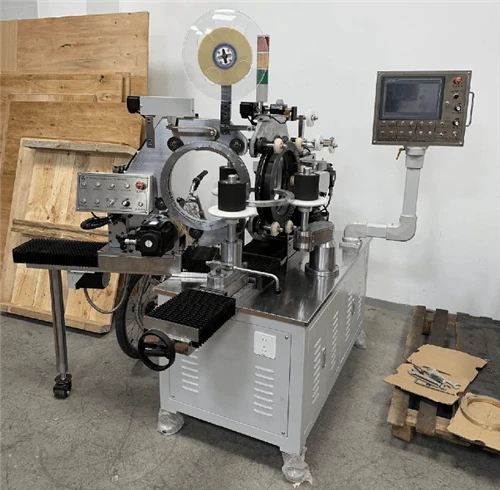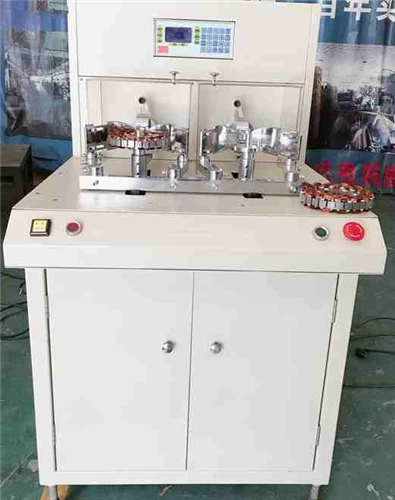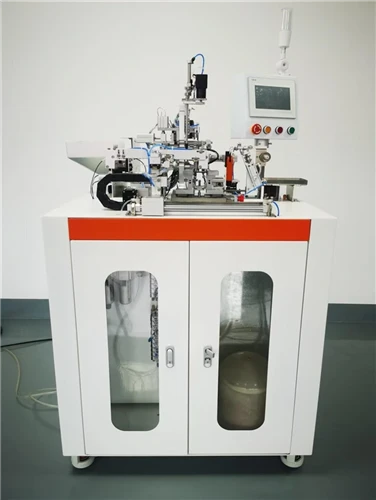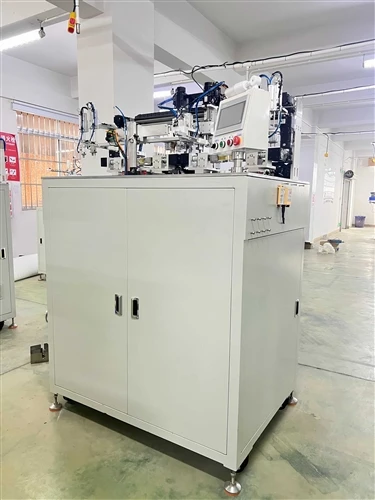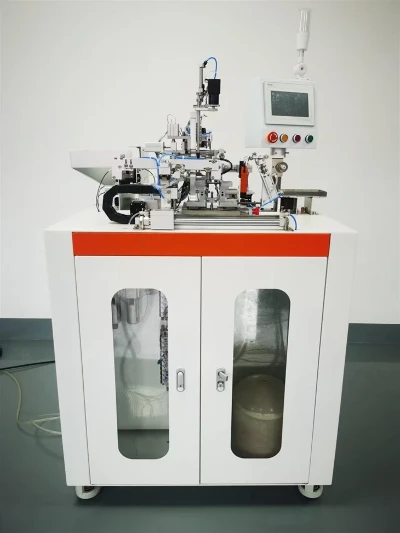


A toroidal transformer winding machine works by passing copper wire through the center hole of a ring-shaped core, rotating the core while a shuttle or wire head carries the wire around it, and using a CNC controller to count turns, hold tension and lay the wire evenly.
In short, how to wind a toroidal transformer comes down to four things: load the core, feed the wire through the window, rotate and wrap with controlled tension, then insulate and finish the leads.
An automatic toroidal winding machine does all four steps without manual wire handling, which gives faster output, consistent turns and a better fill factor than hand winding.
I. What Is a Toroidal Transformer Winding Machine?
a. Definition
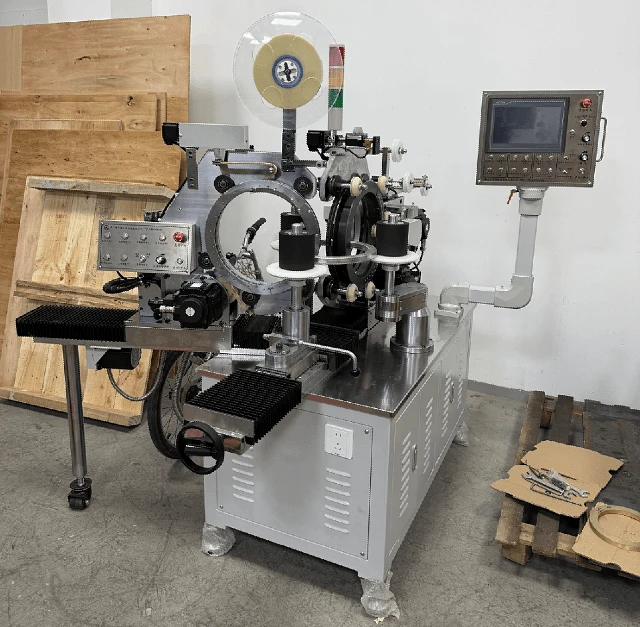
A toroidal transformer winding machine is specialized equipment that winds magnet wire onto closed, donut-shaped cores. These cores are used in toroidal transformers, inductors, common mode chokes and current transformers. See the general background on toroidal inductors and transformers.
b. Why a Toroid Cannot Be Wound Like a Normal Coil
A conventional EI-core transformer is wound on a bobbin, and the core laminations are inserted afterwards. A toroidal core is a closed ring, so there is no bobbin and no opening. The wire has to physically travel through the hole and around the outside of the core for every single turn. That is why a dedicated machine is required, and why winding by hand is slow and inconsistent.
Example 1: A 300 VA power supply transformer. A small workshop winds a 300 VA toroidal transformer by hand: roughly 400 primary turns and several secondary windings, one turn at a time. Operators report slow output, uneven layers and frequent wire damage at the inner diameter.
After moving to a machine-wound process, the same transformer is wound in a fraction of the time with a repeatable turn count. (Illustrative example; actual times depend on wire size and machine type.)
Want to see how a machine would fit your product? Contact KIOXIA for a free winding solution.
II. How Does a Toroidal Winding Machine Work Step by Step?
a. Core Loading and Clamping
The operator, or an automatic loader, places the toroidal core onto the machine. Rollers or a clamping fixture hold the core and rotate it so that every part of its circumference passes through the winding area.
b. Shuttle Opening and Wire Passing
In the most common design, a split ring shuttle (also called a bobbin ring) is preloaded with wire. The ring opens, slides through the core window, and closes again, so the wire supply is now linked to the core.
c. Rotation and Wire Laying
The shuttle spins around the core cross-section, laying one turn per revolution, while the core slowly indexes forward. This indexing is what spreads the turns evenly around the ring instead of piling them in one spot.
d. Tension Control and Turn Counting
A tensioner keeps the wire taut so the winding is tight but the enamel is not damaged. An encoder and the CNC controller count every turn and stop at the programmed value, which is how accuracy is kept within a turn or less.
e. Insulation and Lead Finishing
Between windings, many machines wrap insulation tape automatically. Finally the wire is cut and the start and finish leads are positioned for termination.
Example 2: A 500 VA toroidal transformer for a power amplifier. An audio equipment maker needs a 500 VA unit with a 230 V primary and two secondary windings. The primary is wound first, then insulation tape, then the secondaries. Because the machine repeats the same turn count and tension each time, unit-to-unit variation in output voltage and hum stays low. (Illustrative example.)
Need a similar process for your product? Send us your core size and wire diameter and our engineers will recommend a suitable machine.
III. What Are the Different Types of Toroidal Winding Machines?
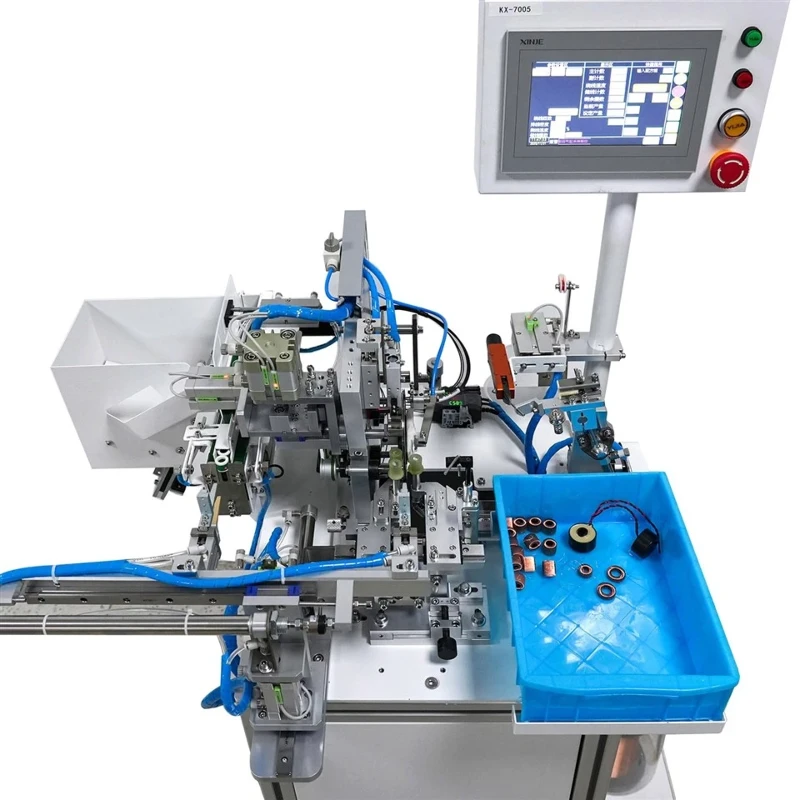
a. Manual, Semi-Automatic and Automatic
|
Type |
Operator Involvement |
Typical Use |
Output Consistency |
|---|---|---|---|
|
Manual toroidal winding machine |
High: operator feeds and guides the wire |
Prototypes, repair, very small batches |
Low to medium |
|
Medium: operator loads core, machine winds |
Small and medium batches |
Medium to high |
|
|
Low: automatic loading, winding, taping and cutting |
Volume production |
High |
b. Shuttle, Hopper and Needle Winding
|
Method |
How It Works |
Best For |
|---|---|---|
|
Shuttle (bobbin ring) |
Ring carries wire through the core window |
Medium to large cores, thicker wire |
|
Hopper / rotary |
Wire is stored in a hopper and fed through a rotating ring |
Small cores, high speed |
|
Needle winding |
A hollow needle passes the wire through the window |
Small ferrite rings, fine wire |
IV. Which Toroidal Core Materials Are Used?
a. Common Core Materials Compared
|
Material |
Typical Saturation Flux Density (approx.) |
Main Strengths |
Typical Applications |
|---|---|---|---|
|
Silicon steel (grain-oriented) |
1.6 to 2.0 T |
Low cost, high flux, good at 50/60 Hz |
Power and audio transformers |
|
Nanocrystalline |
about 1.2 T |
Very low loss, high permeability |
Common mode chokes, high-frequency transformers |
|
Amorphous metal |
about 1.5 T |
Very low no-load loss |
Distribution and energy-efficient transformers |
|
Ferrite |
about 0.3 to 0.5 T |
Low cost, excellent at high frequency |
Small inductors, EMI filters |
|
Powdered iron |
about 1.0 to 1.5 T |
Soft saturation, good DC bias |
Output chokes, PFC inductors |
Values are typical ranges and vary by grade and manufacturer.
b. Why the Silicon Steel Toroidal Core Is So Popular
A silicon steel toroidal core is made by winding a thin grain-oriented strip, commonly 0.23 to 0.35 mm thick, into a ring. The magnetic flux follows the grain direction all the way around, so there are no air gaps and the no-load current is low.
This is why it dominates mains-frequency transformers. Because the strip is thin and the core is hard, the winding machine must be strong enough to handle the core weight and smooth enough not to damage the insulation coating.
V. How Do You Calculate the Turns and Wire for a Toroidal Transformer?
a. Turns per Volt
The core cross-section and the allowed flux density decide the number of turns:
V = 4.44 × f × N × Ac × Bmax, so N / V = 1 / (4.44 × f × Ac × Bmax)
Where V is the winding voltage, f is frequency in Hz, N is the number of turns, Ac is the effective core cross-section in m², and Bmax is the peak flux density in tesla.
The core cross-section is estimated as Ac = Ks × h × (OD − ID) / 2, where Ks is the stacking factor (about 0.95 for tape-wound cores), h is the core height, OD is the outer diameter and ID is the inner diameter.
b. Worked Example
Take a core with OD = 140 mm, ID = 60 mm and h = 60 mm, running at 50 Hz and Bmax = 1.5 T:
Ac = 0.95 × 0.060 × 0.040 = 0.00228 m²
N / V = 1 / (4.44 × 50 × 0.00228 × 1.5) ≈ 1.32 turns per volt
A 230 V primary needs about 230 × 1.32 ≈ 303 turns
c. Wire Length and Window Fill
The mean length of one turn is roughly MLT ≈ 2h + (OD − ID) before the winding build-up is added. In the example, MLT ≈ 120 + 80 = 200 mm, so 303 turns need about 61 m of wire. The window fill factor is:
Ku = (N × Aw) / Wa
Where Aw is the copper cross-section of one wire and Wa is the window area, π × ID² / 4. If Ku is too high the machine cannot pass the shuttle through the window, so this check should be done before choosing wire size.
d. Inductance of a Toroidal Coil
For toroidal inductors and chokes:
L = μ0 × μr × N² × Ac / le, with le = π × (OD + ID) / 2
Where μ0 = 4π × 10⁻⁷ H/m, μr is the relative permeability of the core and le is the mean magnetic path length.
VI. Why Is a Toroidal Transformer Used for an Amplifier?
a. Low Hum and Low Stray Field
A toroidal transformer for an amplifier is popular because the closed ring keeps most of the magnetic flux inside the core. This means less stray field and less audible hum picked up by sensitive audio circuits.
b. Efficiency and Size
Toroidal units are typically smaller and lighter than EI types of the same rating, and they have lower no-load loss.
c. What This Means for Winding
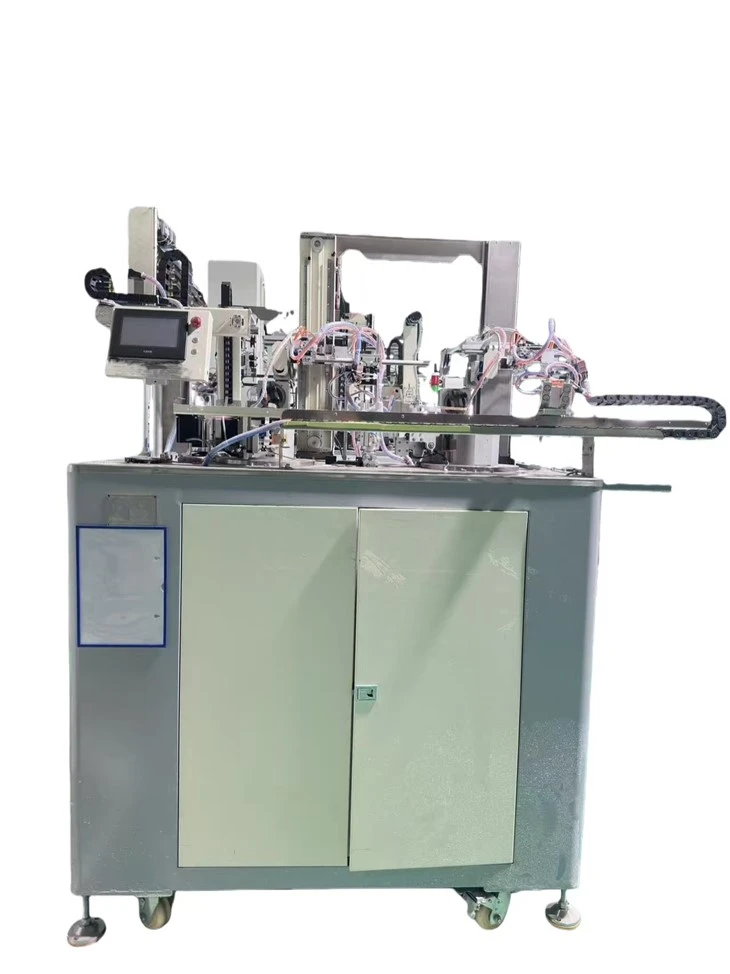
Amplifier transformers usually need evenly distributed windings, good insulation between primary and secondary, and sometimes a screen layer. Consistent tension and even turn spacing, which an automatic machine provides, directly affect noise and regulation.
VII. How Do You Choose an Automatic Toroidal Winding Machine?
a. Key Selection Parameters
|
Parameter |
What to Check |
Why It Matters |
|---|---|---|
|
Core size range (OD / ID / height) |
Largest and smallest core you will wind |
Defines the shuttle and clamp size |
|
Wire diameter range |
Thinnest and thickest wire |
Affects tension system and shuttle type |
|
Winding speed (RPM) |
Output needed per shift |
Sets production capacity |
|
Control system |
CNC / PLC with touch screen and program storage |
Quick changeover between products |
|
Extra functions |
Auto taping, wire cutting, core loading |
Cuts labor and cycle time |
|
After-sales support |
Spare parts, training, warranty |
Reduces downtime |
b. Quality and Safety Standards
Finished transformers are normally evaluated against safety standards such as IEC 61558 (see the IEC website), and a supplier running a certified quality system such as ISO 9001 is a good sign of consistent manufacturing.
c. Common Problems and How to Avoid Them
Typical issues are wire breakage from excessive tension, uneven layers from poor indexing, and scratched enamel from rough guides. Choosing a machine with stable tension control and smooth wire guides avoids most of these.
VIII. Why Choose KIOXIA for Toroidal Winding Equipment?
KIOXIA is a Tianjin-based manufacturer of transformer coil winding machines, supplying customers in India, Europe, Russia and Southeast Asia.
Whether you are producing toroidal transformers for amplifiers, power supplies, current transformers or chokes, KIOXIA can recommend and customize an automatic toroidal winding machine to match your core size, wire diameter and output target.
You may be interested in:
Overcoming Shuttle and Winding Head Pitch Issues in CNC Toroidal Winding
Concentrated vs Distributed Winding Comparison
Slider Head Winding Tension Adjustment Guide
Concentrated Winding and Distributed Winding: Differences Explained