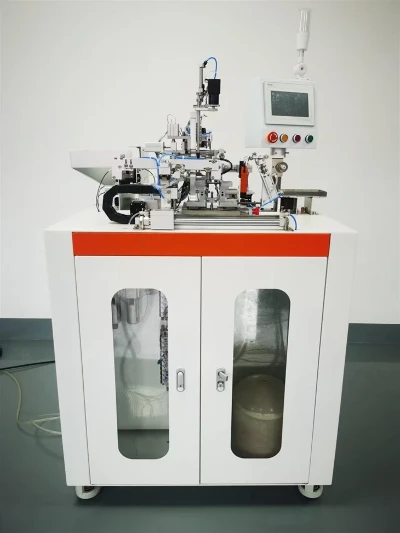


Short answer: The toroidal vs EI transformer decision comes down to a trade-off between performance and cost. Among the common transformer core types, a toroidal transformer uses a seamless ring-shaped core, so it delivers higher efficiency, lower no-load loss, very low hum and a smaller footprint, but it costs more and is harder to wind.
An E-I transformer uses stacked laminations, so it is cheaper, easier to build, and easy to tap for multiple voltages, but it has higher core loss, more stray flux and an audible hum. Choose toroidal for audio, medical, precision and space-limited designs; choose E-I for general industrial power and budget-driven projects. Details, formulas and examples follow below.

I. What Are the Main Transformer Core Types, and How Do Toroidal and E-I Cores Differ?
a. E-I laminated core
An E-I core is built from stacked E-shaped and I-shaped steel laminations that are interleaved around a bobbin. The winding sits on a square or rectangular bobbin inside the core window. It is the most widely used of all transformer core types because the stamping process is cheap and the bobbin can be wound on simple equipment.
b. Toroidal core
A toroidal core is a continuous ring of wound grain-oriented silicon steel strip. The primary and secondary windings are distributed evenly around the whole ring. Because the magnetic path is closed and has no air gap, the flux stays inside the core.
c. Quick comparison
|
Feature |
Toroidal transformer |
E-I transformer |
|---|---|---|
|
Core construction |
Continuous wound ring |
Stacked E and I laminations |
|
Typical core material |
Grain-oriented silicon steel |
Non-oriented silicon steel |
|
Air gap |
None |
Small gaps at lamination joints |
|
Typical flux density |
1.5 to 1.7 T |
1.2 to 1.4 T |
|
Efficiency |
Higher (typically 95% to 98%) |
Lower (typically 85% to 95%) |
|
Stray magnetic field |
Very low |
Higher |
|
Audible hum |
Very low |
Noticeable |
|
Size and weight |
Smaller, lighter |
Larger, heavier |
|
Cost |
Higher |
Lower |
|
Winding difficulty |
High |
Low |
II. Which Transformer Is Right for Your Application? Real-World Examples
a. Where a toroidal transformer is the better choice
A toroidal transformer fits equipment where noise, electromagnetic interference (EMI), temperature rise and space are all tightly limited. Typical examples:
Audio amplifier transformer: A high-end power amplifier needs a very quiet supply. The low stray flux keeps hum out of the signal path, and the seamless core avoids mechanical buzz.
Medical equipment: Patient monitors and diagnostic devices need low leakage current, low EMI and cool operation inside sealed enclosures.
Precision instruments: Measuring and laboratory instruments are sensitive to stray fields, so the closed magnetic path protects their readings.
Servo control power supplies: Compact drive cabinets need a small, efficient power source with low heat.
Space-limited devices: Where height and volume are tight, the compact ring shape saves a lot of room.
Limitations: A toroidal transformer is sensitive to DC bias (a small DC component can saturate the gapless core), it has a higher purchase price, and it is difficult to wind because the wire has to be fed through the center of the ring. This is exactly the problem a dedicated toroidal winding machine solves.
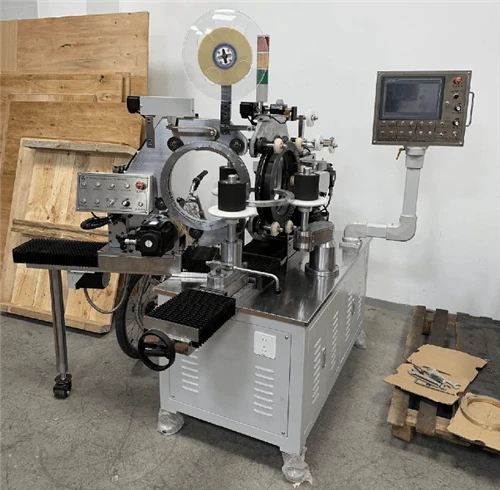
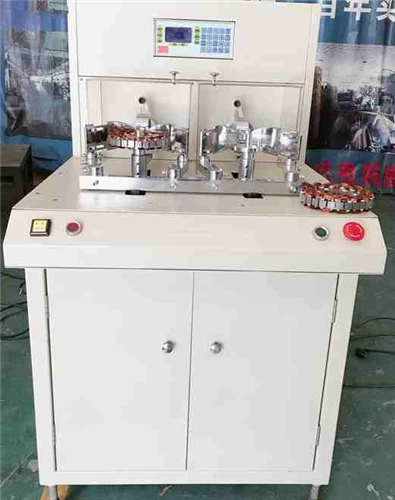
Need to produce toroidal transformers more efficiently? KIOXIA toroidal winding machines are built for stable tension and consistent turns. Contact us to discuss your winding requirements.
b. Where an E-I transformer is the better choice
An E-I transformer is a practical choice when cost, simple structure and flexibility matter more than size or noise:
General industrial equipment: Machine tools and standard control cabinets can tolerate a larger, noisier transformer.
High-power distribution: At larger ratings, E-I construction is easier to manufacture, mount and cool.
Multi-tap, multi-voltage outputs: The bobbin structure makes it easy to add several secondaries and taps.
Budget-limited projects: Cheaper material and simpler winding keep the unit price low.
Harsh environments: Where leakage flux and hum are not a concern, E-I is robust and easy to replace.
SCR (thyristor) voltage regulation: Its higher leakage inductance helps limit current surges in phase-controlled circuits.
Limitations: Lower efficiency, larger stray flux, audible hum and a bigger, heavier body.
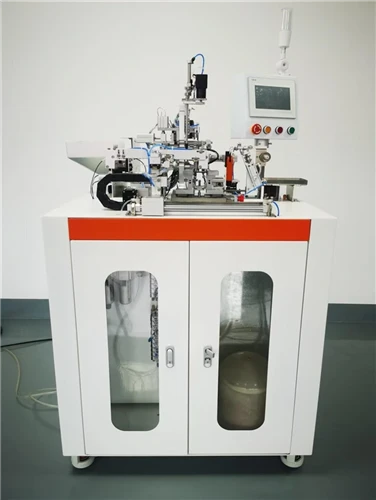
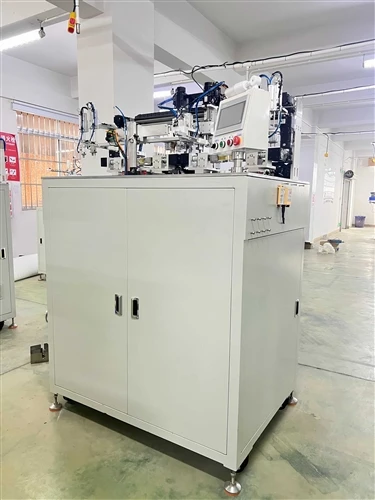
Producing E-I or bobbin-type transformers at volume? Our coil winding machines support high-speed, repeatable production. Send us your specifications and we will suggest a suitable machine.

III. Which One Has Lower No-Load Loss and Core Loss?
a. How no-load loss and core loss are calculated
No-load loss (also called iron loss) is the power a transformer consumes when the secondary is open. It is almost entirely core loss, made up of hysteresis loss and eddy-current loss. A common approximation is the Steinmetz equation:
P_core = k · f^α · B_max^β · V_core
where k, α and β are material constants, f is frequency in Hz, B_max is peak flux density in tesla, and V_core is core volume. Lower specific loss (W/kg) in the steel and a smaller core mass both reduce no-load loss.
In practice, the loss can be estimated as:
P_0 = p_fe × m_core
where p_fe is the steel's specific loss in W/kg at the working flux density and m_core is the core mass in kg.
b. Worked example (300 VA, 50 Hz)
The numbers below are illustrative. Always check the steel supplier's datasheet for exact values.
|
Item |
Toroidal |
E-I |
|---|---|---|
|
Steel type |
Grain-oriented |
Non-oriented |
|
Specific loss p_fe |
about 1.2 W/kg |
about 3.0 W/kg |
|
Core mass |
about 1.5 kg |
about 2.4 kg |
|
No-load loss P_0 |
about 1.8 W |
about 7.2 W |
|
No-load loss as % of 300 VA |
about 0.6% |
about 2.4% |
Full-load efficiency follows from:
η = P_out / (P_out + P_fe + P_cu)
With P_out = 300 W and copper losses of about 9 W (toroidal) and 12 W (E-I, longer mean turn length):
Toroidal: η = 300 / (300 + 1.8 + 9) ≈ 96.5%
E-I: η = 300 / (300 + 7.2 + 12) ≈ 94.0%
For equipment that stays energized around the clock, this gap in no-load loss adds up to a real saving in electricity and heat.
c. Turns per volt and core area
The number of primary turns is set by the EMF equation:
N = E × 10⁶ / (4.44 × f × A_c × B_max)
where E is the voltage in volts, f the frequency in Hz, A_c the core cross-section in mm², and B_max in tesla.
Example for a 230 V, 50 Hz primary with A_c = 1,200 mm²:
At B_max = 1.5 T (typical toroidal): N = 230 × 10⁶ / (4.44 × 50 × 1,200 × 1.5) ≈ 576 turns
At B_max = 1.2 T (typical E-I): N = 230 × 10⁶ / (4.44 × 50 × 1,200 × 1.2) ≈ 720 turns
Grain-oriented steel can run at higher flux density, so a toroidal design needs fewer turns for the same core area, which also helps keep copper loss down.
IV. Why Is a Toroidal Transformer a Low Noise Transformer?
a. Hum and magnetostriction
Hum comes mainly from magnetostriction (the steel changes length slightly as it magnetizes) and from vibration at lamination joints. A wound toroidal core has no joints and no loose laminations, and the winding holds the ring tight, so a toroidal unit works as a true low noise transformer. In E-I units, loose laminations and air gaps vibrate at twice the line frequency (100 Hz or 120 Hz), which is the familiar buzz.
b. Leakage flux and EMI
Because the toroidal flux path is closed and evenly wound, little flux escapes. An E-I transformer leaks more flux near the window and joints, which can couple into nearby cables, sensors and audio circuits.
c. Inrush current and DC bias
Toroidal transformers are not better in every respect. Their low leakage inductance and high working flux density can produce a larger switch-on inrush current, often several times higher than an E-I unit of the same rating, so a soft-start circuit or slow-blow fuse is recommended. A gapless toroidal core also saturates more easily from DC offset on the mains, so it is less suitable where DC bias is present.
|
Characteristic |
Toroidal |
E-I |
|---|---|---|
|
Audible hum |
Very low |
Noticeable |
|
Stray flux / EMI |
Very low |
Higher |
|
Switch-on inrush current |
Higher |
Lower |
|
Tolerance to DC bias |
Low |
Moderate |
V. How Do They Perform as a Low Voltage Transformer or an Industrial Control Transformer?
a. Low voltage transformer (for example 12 V, 24 V)
A low voltage transformer delivers high current from a small secondary voltage, so the secondary uses thick wire. Secondary current is:
I = S / V
For a 100 VA unit with a 24 V secondary, I = 100 / 24 ≈ 4.2 A. Copper loss (I²R) is a larger share of total loss in these designs, and the shorter, evenly distributed winding path of a toroid helps keep resistance and temperature rise down. The trade-off is that heavy secondary wire is harder to wind around a ring, so low-voltage toroids benefit most from machine winding.
b. Industrial control transformer
An industrial control transformer feeds contactors, relays, solenoids and PLC power supplies. Here the key factors are voltage regulation under inrush load, multiple input taps and low cost, so E-I construction is the usual choice. Voltage regulation is:
VR (%) = (V_no-load − V_full-load) / V_full-load × 100
A good control transformer holds regulation low enough that contactor coils pull in reliably. When sizing, add up all loads (VA = V × I for each), then include a margin of about 20% to 25% and check that the voltage does not sag excessively when contactors close.
A toroidal control transformer is worth the extra cost when the cabinet is very compact or when sensitive electronics share the enclosure.

VI. Why Is a Toroidal Transformer More Expensive, and How Does Winding Affect Cost?
a. Material and process cost
Grain-oriented steel strip and the ring-forming process cost more than stamped laminations. Even so, a toroidal unit can use less steel and copper for the same rating, which partly offsets the price.
b. Winding difficulty
The main cost driver is labor. On an E-I transformer, wire goes onto a bobbin that spins on a simple winding machine. On a toroid, the wire must pass through the center of the ring for every turn, using a shuttle or ring-opening mechanism, and the layers must be kept even to control the space factor and avoid damaging the enamel. Winding by hand is slow and the results vary between operators.
c. How an automatic winding machine changes the cost picture
An automatic winding machine controls turns count, tension and layer pitch electronically, so each coil matches the last. This shortens cycle time, reduces enamel wire damage and scrap, and lowers the labor share of unit cost, which narrows the price gap between toroidal and E-I transformers.
|
Winding method |
Consistency |
Speed |
Scrap risk |
Best for |
|---|---|---|---|---|
|
Manual |
Low |
Slow |
High |
Prototypes, repairs |
|
Semi-automatic |
Medium |
Medium |
Medium |
Small batches |
|
Automatic winding machine |
High |
Fast |
Low |
Volume production |
VII. Which Standards Apply to Toroidal and E-I Transformers?
a. Safety standards
Small power, isolating and control transformers are generally evaluated against the safety requirements in the IEC 61558 series covering safety of transformers, reactors and power supply units. Insulation class, creepage distances, temperature rise limits and dielectric strength all apply to both core types.
b. Performance and application standards
In North America, dry-type transformer ratings and test methods are covered by standards published by NEMA. Check which standard your target market requires before you finalize the design, since requirements for insulation, marking and test voltage can differ by region.
VIII. How Do You Choose Between a Toroidal and an E-I Transformer?
a. Decision table
|
If your priority is... |
Choose |
|---|---|
|
Lowest noise and hum |
Toroidal |
|
Lowest EMI and stray flux |
Toroidal |
|
Highest efficiency, lowest no-load loss |
Toroidal |
|
Small size, low weight |
Toroidal |
|
Lowest purchase price |
E-I |
|
Multiple taps and outputs |
E-I |
|
DC bias present on the line |
E-I |
|
Low inrush current |
E-I |
|
Simple, low-cost production |
E-I |
b. Rule of thumb
If the transformer will sit near sensitive electronics, run continuously, or fit in a tight enclosure, a toroidal design usually repays its higher price. If the application is general industrial power where size and noise do not matter, an E-I transformer is the economical answer.
IX. Where Can You Get Winding Equipment for Toroidal and E-I Transformers?
Whichever core you choose, the quality of the winding decides the final performance: turns accuracy, tension control, layer uniformity and insulation integrity all affect loss, temperature rise and noise.
KIOXIA , a Tianjin-based manufacturer of transformer coil winding machines, supplies toroidal winding machines, automatic winding machines and bobbin coil winding equipment for transformer, inductor and choke production. Our machines are used by manufacturers across India, Europe, Russia and Southeast Asia, and we can configure them for your wire size, core size and output target.
Visit transformercoilwindingmachine.com or contact the KIOXIA team with your core dimensions, wire diameter and daily output requirement, and we will recommend a suitable machine and quote.
You may be interested in:
Overcoming Shuttle and Winding Head Pitch Issues in CNC Toroidal Winding
Concentrated vs Distributed Winding Comparison
Slider Head Winding Tension Adjustment Guide