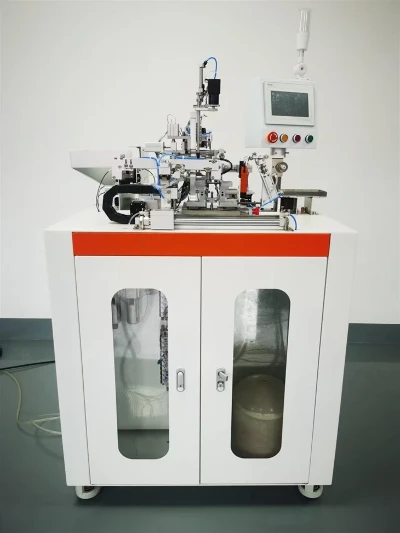


Preventing deformation in air coil winding comes down to controlling three things at once: wire tension during winding, the bonding method used to hold turns together, and how the coil is released from its mandrel - get any one wrong and a bobbinless coil winding loses its shape the moment it's removed from the form.
Unlike bobbin-wound coils, which rely on a permanent plastic or ceramic former for structural support, self-supporting air coils must generate their own rigidity, typically through self-bonding wire activated by heat or solvent during the winding process.
Below, we break down why springback happens, the tension math behind it, and the bonding and mandrel techniques that keep a coil round and rigid long after it leaves the machine.

I. Why Do Bobbinless Coils Lose Their Shape After Winding?
An air coil has no permanent structural support, so the moment winding tension is released, the wire's natural elasticity pulls the coil back toward its unwound shape - a phenomenon known as springback.
a. what causes springback
Every wire has some elastic memory; when it's bent around a mandrel under tension, part of that deformation is elastic (temporary) rather than plastic (permanent), and the elastic portion tries to reverse itself once the mandrel is removed.
b. why this is worse for self-supporting coils than bobbin coils
A bobbin coil never has to fight springback because the bobbin itself holds the shape permanently; a bobbinless coil has nothing else to rely on, so the winding and bonding process has to do all the structural work the bobbin would otherwise provide.
II. How Much Force Does the Coil Need to Resist to Stay Round?
Winding tension creates residual hoop stress in the finished coil - the same force that helped shape it during winding is also the force trying to spring it back open afterward.
Hoop stress formula:
σ = F / A
Where:
σ = residual hoop stress in the wire (N/mm², equivalent to MPa)
F = wire tension applied during winding (N)
A = wire cross-sectional area (mm²), calculated as A = π × (d/2)²
Worked example: for 0.5mm diameter wire wound at 2N tension:
A = π × (0.25)² ≈ 0.196 mm²
σ = 2 / 0.196 ≈ 10.2 N/mm² (MPa)
a. what this number tells you
This residual stress is what the bonding joints between turns must resist to keep the coil from springing open - the bonding method needs to hold against roughly this much stress per unit area, which is why bonding strength and winding tension have to be matched, not chosen independently.
b. why higher tension isn't always better
Increasing tension improves winding density and consistency, but it also raises the residual stress the bond has to overcome - pushing tension too high without a correspondingly strong bonding method actually increases the risk of deformation, not the reverse.

III. What Bonding Methods Keep a Self-Supporting Coil Rigid?
Self-bonding wire is coated with a secondary layer, in addition to standard enamel insulation, that activates and fuses adjacent turns together when triggered by heat, solvent, or current.
| Bonding Method | How It Activates | Best For |
|---|---|---|
| Heat-activated self-bonding wire | Hot air or oven post-winding | General-purpose air coils |
| Solvent-activated bonding | Solvent applied during/after winding | Coils sensitive to heat exposure |
| Current-activated bonding | Current passed through wire generates internal heat | High-volume production lines |
| External varnish impregnation | Coil dipped or coated after winding | Coils needing extra mechanical strength |
a. why activation method affects deformation risk
Heat- and current-activated bonding fuse turns while the coil is still on the mandrel and under tension, locking in the wound shape before springback has a chance to occur - bonding after the coil is removed from the mandrel is far less effective at preventing shape loss.
b. why bond coverage matters as much as bond strength
A coil with strong bonding only at a few contact points can still deform between bonded areas, so uniform activation across the full winding - not just strong bonding at isolated turns - is what actually prevents deformation.
IV. How Does Mandrel Design Affect Coil Deformation?
The mandrel a coil is wound on directly influences both winding accuracy and how cleanly the finished coil releases without distortion.
a. mandrel material and surface finish
A mandrel with a smooth, low-friction surface (often coated or polished) allows the finished coil to slide off cleanly, while a rough or tapered mandrel can drag and distort the coil shape during release.
b. mandrel diameter and springback compensation
Because the coil will spring back slightly larger than the mandrel diameter once released, mandrels are often sized marginally undersized relative to the target finished coil diameter to compensate for this predictable elastic recovery.

V. What Machine Capabilities Matter Most for Bobbinless Winding?
Producing consistent self-supporting coils depends heavily on the winding machine's ability to control tension precisely and, where applicable, integrate bonding activation into the winding cycle itself.
| Machine Capability | Why It Matters for Air Coils |
|---|---|
| Closed-loop tension control | Keeps residual stress consistent turn to turn, avoiding uneven springback |
| Integrated heat/current bonding station | Activates self-bonding wire while coil is still on the mandrel |
| Programmable turns and pitch control | Ensures uniform winding density across the coil |
| Precision mandrel indexing | Supports clean, repeatable coil release |
a. why tension consistency matters more here than in bobbin winding
In bobbin-wound coils, the bobbin absorbs minor tension inconsistency without affecting final shape; in bobbinless winding, every tension variation directly translates into uneven residual stress and inconsistent springback across the coil.
VI. Which KIOXIA Machine Supports Reliable Air Coil Production?
Consistent self-supporting coil production depends on tension precision and process control working together, not just raw winding speed.
KIOXIA Light Ring Equipment Group's precision winding platforms are built with the closed-loop tension control that bobbinless coil production requires, helping keep residual stress predictable across every coil in a production run.
For manufacturers working with self-bonding wire and tight shape-retention tolerances, working directly with an experienced coil winding machine manufacturer on tension settings and mandrel selection is often what separates a consistently round coil from one prone to deformation after release.