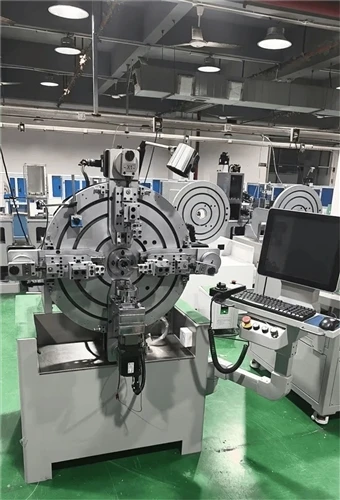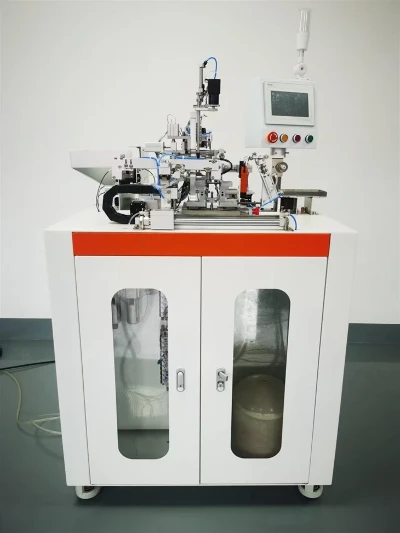


CNC stands for Computer Numerical Control, and a CNC winding machine is a programmable coil winding machine in which a stored program, rather than gears or operator skill, sets spindle speed, turns count, wire position, and tension.
The program drives a traverse mechanism that lays each turn at the right pitch while the spindle rotates, so the same coil can be wound identically thousands of times and changed to a new design by loading a different recipe.
Compared with older NC machines, CNC adds a computer in the controller, which is what allows programs to be stored, edited at the machine, and corrected during winding.
Below, we explain what CNC means in machining, show real application cases from KIOXIA's range, work through the formulas that tie spindle speed to traverse speed, and cover the main machine types.

I. What Does CNC Stand for in Machining, and What Does It Mean for Winding?
In machining, CNC means Computer Numerical Control: a computer reads a program of numbers and turns it into precise axis movements. In winding, the axes are the spindle that rotates the work and the traverse that guides the wire, and the program tells them how fast to move and how far.
| Feature | NC Machine | CNC Machine |
|---|---|---|
| Control logic | Hard-wired circuits | Computer or microprocessor |
| Program storage | Punched tape or fixed settings | Digital memory, many programs stored |
| Editing at the machine | Not practical | Yes, through a screen or keyboard |
| Correction while running | Limited | Compensation, alarms, and adjustments possible |
| Typical winding result | Fixed pattern per setup | Different coils by loading a recipe |
a. cnc vs nc machine: what actually changed
An NC machine follows a fixed set of instructions, while a CNC machine has a computer that can store, edit, and recalculate them. For coil winding, that means turns count, pitch, speed, and tension become settings in a recipe, not mechanical adjustments.
b. why this matters for coil quality
Because the numbers are set digitally, two machines loaded with the same recipe wind the same coil, and a new operator can reproduce a design without relying on the previous operator's feel.
II. What Do Real CNC Winding Applications Look Like?
The table below lists application examples from KIOXIA's CNC winding range, with the results reported for each.
| Application | Machine Configuration | Reported Result |
|---|---|---|
| Medical micro toroidal transformers | Dedicated CNC machine with dual closed-loop tension control | Tension ±3 g, 99.7% yield, material loss down 90% |
| Flat wire for EV drive motors | Six-axis linked flat wire winding with 3D dynamic compensation | Fixes flat-wire edge flipping; insulation damage rate below 0.3% |
| 5G base-station power supplies | Multi-specification toroidal winding | Changeover time down 80% |
| 5G base-station filter toroidal transformers | Dual-wire parallel winding | Efficiency up 60% |
| Inductors and relay coils | Multi-axis precision winding, 3, 4, 6, 8, 12, 16, or 24 axes | Reference application for multi-axis machines |
| Air-core micro inductors, fine wire | 12-axis winding | Spindle speed 12,000 rpm |
| UPS and converter inductors | Gear-type toroidal winding | Wire 1.0–2.8 mm, outer diameter 80–200 mm |
| Current transformers (CT) | Rectangular and oval special winding | Shaped coils for CT production |
| R&D and small batch | Desktop winding machine | 200 mm winding diameter, about 20 kg, stepper drive up to 2,000 rpm |
a. what these examples show
Each result traces to a parameter the CNC program controls. The first row's ±3 g tension and 99.7% yield come from tension control built into the program. The flat-wire row depends on the program coordinating several axes at once. The changeover result comes from loading a stored recipe instead of resetting the machine by hand.
b. how to read the transformer and motor cases
A CNC transformer winding machine is mainly judged on turns accuracy and tension, as in the medical and 5G rows. A CNC motor winding machine is mainly judged on coordinating axes and protecting the wire, as in the flat-wire EV motor row.
Winding a similar product and want to see whether a CNC configuration fits your coil? Contact our team with your wire size, core or stator size, and target output, and we will recommend a machine.

III. How Does a CNC Winding Machine Work?
A CNC winding machine has four working parts: a controller that holds the program, drives that move the axes, sensors that feed back position, and the mechanical axes themselves.
| Part | Function |
|---|---|
| Controller and screen | Holds recipes; sets turns, speed, pitch, and tension |
| Servo or stepper drive | Moves the spindle and traverse as commanded |
| Encoder | Reports spindle position so turns are counted and the traverse stays synchronized |
| Traverse mechanism | Guides the wire sideways, usually on a lead screw or ball screw, laying each turn at the set pitch |
| Tensioner | Holds wire tension at the set value |
a. how spindle and traverse stay synchronized
For close winding, the traverse must advance one wire diameter per spindle revolution. The relationships below follow from that:
Traverse speed: v = n × p
Turns per layer = W / p
Winding time = N / n
Where n is spindle speed (rpm), p is pitch (mm per turn, about the wire's overall diameter), W is winding width (mm), and N is total turns.
Worked example: wire with 0.53 mm overall diameter, a 20 mm winding width, 1,110 turns, and a spindle at 1,500 rpm:
Traverse speed = 1,500 × 0.53 = 795 mm/min (about 13.3 mm/s)
Turns per layer = 20 / 0.53 ≈ 37.7, so 37 whole turns
Layers = 1,110 / 37 = 30 layers
Winding time = 1,110 / 1,500 = 0.74 min, about 44 seconds, before acceleration and reversal time
b. why the traverse mechanism limits quality
If the traverse lags or overshoots at each layer reversal, turns pile up at the flange or leave gaps, and the coil is uneven. That is why machines slow the traverse on a programmed curve at each reversal, so tension stays steady as direction changes.
IV. What Are the Main Types of CNC Winding Machines?
| Type | What It Winds | Typical Products |
|---|---|---|
| CNC transformer winding machine | Bobbins and toroidal cores | Power, signal, and current transformers |
| Toroidal CNC winding machine | Ring cores | Chokes, common mode inductors, CT cores |
| CNC motor winding machine | Stators and flat-wire coils | Fan, EV, and servo motors |
| Multi-axis precision winder | Many small coils at once, 3 to 24 axes | Inductors, relay coils |
| Desktop CNC winder | One or a few coils | R&D and small batches |
a. is a programmable coil winding machine the same thing?
In practice yes: "programmable" describes what the user can do, and "CNC" describes how the controller does it. Simple programmable machines may store only a turns count and speed, while a full CNC machine also coordinates traverse, pitch, tension, and several axes.

V. How Does CNC Compare with Manual and Mechanical Winding?
| Factor | Manual | Mechanical (gear or cam) | CNC |
|---|---|---|---|
| Turns accuracy | Operator dependent | Good for one design | Programmed and repeatable |
| Changeover | Fast to start, slow to repeat | Slow, parts or gears change | Load a recipe |
| Winding pattern | Operator skill | Fixed by the mechanism | Pitch and layers set in the program |
| Tension control | By hand | Fixed friction | Set and adjustable |
| Best for | Prototypes | Single high-volume design | Mixed products and tight tolerances |
a. when mechanical machines still make sense
A purely mechanical machine can be cost-effective if you only ever wind one coil design. Once the product mix changes, the cost of changeovers usually outweighs the lower purchase price.
VI. What Standards Apply to CNC Programs and Wound Products?
The program format used by many numerically controlled machines is defined in ISO 6983-1, the standard for numerical control program format, commonly known as G-code programming. For motors, the finished wound product must meet the rating and performance requirements in IEC 60034-1, the international standard for rotating electrical machines.
a. why this matters when choosing a machine
Controllers differ in how they take programs, so ask how a recipe is entered and stored, and check that the machine can reproduce the winding accuracy your product standard requires.
VII. Which KIOXIA Machine Fits Your Coil?
KIOXIA Light Ring Equipment Group's CNC range covers the application types above, including toroidal winding for transformers and chokes, multi-axis precision winding, flat-wire motor winding, and a desktop model for R&D.
The KX-100J 8-axis winding machine uses a 32-bit ARM microprocessor with a Xilinx CPLD, an English LCD interface, and non-volatile memory that retains winding data after a power loss, so a job can resume from its last position. The KX-7005 is a CNC toroidal machine for chokes and toroidal transformers.
If you are choosing between machine types, working with an experienced coil winding machine manufacturer on wire size, core or stator size, and output target is the fastest way to narrow the options.
Explore the full lineup at transformercoilwindingmachine.com to find a CNC winding solution for your product.
You may be interested in:
Why Are High-Power Transformers More Likely To Use Flat Copper Wire Instead Of Round Copper Wire?
Toroidal Transformer Failure: Causes & Prevention
Key Machinery Required To Build A Semi-Automated Transformer Factory From Scratch