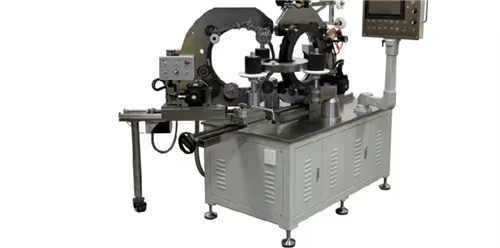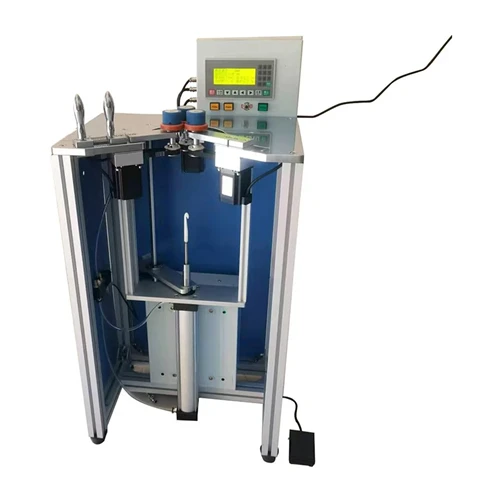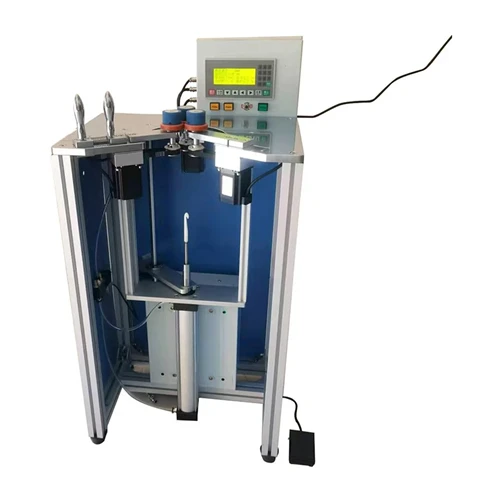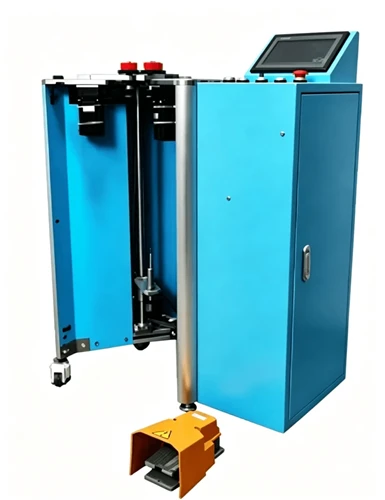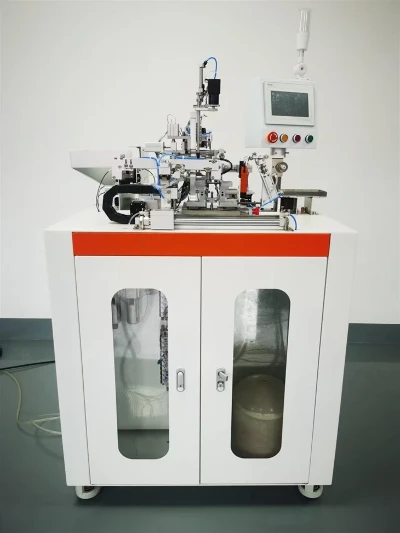


Closed loop tension control lets a servo motor toroidal winding machine hold fine wire tension close to its setpoint for the whole winding cycle, while an open-loop brake or spring lets tension drift by 50% or more as the supply spool empties and the winding speed changes.
On a toroidal transformer winding machine running wire thinner than about 0.2 mm, that drift is the difference between clean, repeatable coils and broken wire, cracked enamel and uneven layers.
In short: set the starting tension at 10–20% of the wire's breaking force, use a sensor-based controller that measures real tension instead of guessing it, and confirm the result with resistance, inductance and insulation tests on trial coils.

I. Why Does Wire Tension Control Matter So Much for Fine Wire?
a. Wire strength falls with the square of its diameter
The breaking force of a copper wire is its tensile strength multiplied by its cross-section area. Because area depends on the diameter squared, halving the diameter cuts the breaking force to a quarter.

The table below uses 220 MPa as a typical tensile strength for annealed copper and a starting tension of 10–20% of the breaking force.
|
Wire diameter (mm) |
Approx. AWG |
Cross-section (mm²) |
Breaking force |
Starting tension (10–20%) |
|---|---|---|---|---|
|
0.05 |
44 |
0.0020 |
0.43 N (44 gf) |
4–9 gf |
|
0.10 |
38 |
0.0079 |
1.73 N (176 gf) |
18–35 gf |
|
0.20 |
32 |
0.0314 |
6.91 N (705 gf) |
70–141 gf |
|
0.30 |
29 |
0.0707 |
15.55 N (1586 gf) |
159–317 gf |
Worked example for 0.1 mm wire: A = π × 0.1² / 4 = 0.00785 mm², so F_break = 0.00785 × 220 = 1.73 N, about 176 gf. A 15% starting tension is about 0.26 N, or 26 gf. These are planning values only; always check the real wire against its datasheet and the magnet wire standards, such as IEC 60317-0-1 for enamelled round copper wire and NEMA MW 1000, now designated MW 01000.
b. What happens to magnet wire when tension drifts
Wire breakage. A spike of only a few grams can exceed the limit of 0.05 mm wire.
Insulation damage. Too much tension stretches the wire and thins or cracks the enamel at the core edges, which causes turn-to-turn shorts and failed insulation tests.
Loose turns and uneven layers. Too little tension leaves slack, so the coil is bulky and its inductance varies from piece to piece.
Resistance spread. Stretched wire has a smaller cross-section, so winding resistance changes along with it.
Good wire tension control keeps every one of these in check, which is why it matters more as the wire gets thinner.
II. What Does Poor Tension Look Like on a Real Production Line?
a. A typical case: breakage that grows as the spool empties
Here is a typical case, described in general terms. A maker of toroidal chokes winds 0.1 mm enamelled wire on small cores using a mechanical spring tensioner. The first coils from a fresh spool pass inspection. As the spool empties, wire breaks become more frequent and more coils fail the insulation test. The operator's only remedy is to readjust the spring by hand every few spools, and two operators never set it the same way.
b. The fix: measure tension instead of assuming it
After moving to a servo motor toroidal winding machine with a load-cell feedback loop, the tension setpoint is stored in the product recipe and held from the first turn to the last, whatever the spool diameter. Breakage stops tracking the spool level, and the result no longer depends on who runs the shift. The operator was never the real problem: an open-loop tensioner cannot see what the wire is doing, so it cannot correct it.
Winding 0.1 mm wire or thinner? Contact KIOXIA and send us your wire diameter and core size.

III. How Does Closed Loop Tension Control Work?
a. The feedback loop in four steps
A sensor, usually a load cell or a dancer arm with an encoder, measures the actual wire tension.
The wire tension controller compares the measured value with the setpoint stored in the recipe.
The controller adjusts the torque or speed of the servo tensioner or pay-off motor.
The loop repeats many times per second, so a disturbance is corrected before it becomes a broken wire.
Most controllers use a PID law, where e(t) is the error between setpoint and measured tension:

b. Open loop versus closed loop
|
Feature |
Open loop (brake or spring) |
Closed loop (sensor + servo) |
|---|---|---|
|
Knows actual tension |
No |
Yes, measured continuously |
|
Reacts to spool diameter change |
No |
Yes |
|
Reacts to speed changes |
Limited |
Yes |
|
Setting repeatable between operators |
Depends on the operator |
Stored as a recipe value |
|
Best suited to |
Thick wire, low precision |
Fine wire, tight tolerances |
c. Worked example: why a fixed brake fails
With a fixed brake torque M, wire tension at the spool is:

Suppose you set 0.26 N (about 26 gf) for 0.1 mm wire when the spool radius r is 50 mm. The brake torque is M = 0.26 × 0.05 = 0.013 N·m. When the spool empties to r = 25 mm, the same torque gives F = 0.013 / 0.025 = 0.52 N, about 53 gf. Winding tension control by feel has just doubled the tension, pushing it above the 18–35 gf range in the table, and nobody touched the machine. A closed loop measures the rise and reduces brake torque to compensate.
IV. How Do You Set Winding Tension for a Magnet Wire Winding Machine?
a. Start from the breaking force

Use the lower end of k for ultra-fine wire, high winding speed or thin insulation, and the upper end for thicker wire and slower cycles. These are typical starting points to be confirmed by test, not fixed rules.
|
Condition |
Suggested k |
|---|---|
|
Wire below 0.05 mm, or high winding speed |
0.10–0.12 |
|
Wire 0.05–0.20 mm, normal speed |
0.10–0.15 |
|
Wire above 0.20 mm, slow cycle |
0.15–0.20 |
Example for 0.1 mm wire at k = 0.15: T_set = 0.15 × 1.73 N ≈ 0.26 N, or about 26 gf.
b. Check the stress inside the wire

At 0.26 N on 0.00785 mm² of copper, the stress is about 33 MPa. At the doubled 0.52 N from the brake example it is about 66 MPa. Annealed copper starts to stretch permanently at a stress far below its tensile strength, so a tension that looks safe against the breaking force can still change the wire. Confirm the yield behaviour with your wire supplier.
c. Tune with test coils
Enter the starting value and wind a few test cores at low speed.
Inspect the layers under magnification for slack turns and enamel damage.
Measure resistance and inductance on every test coil and compare the spread.
Raise the speed in steps, watching for tension spikes at start, stop and direction changes.
Save the final value in the product recipe so every shift runs the same setting.

V. Do You Need a Toroidal Winding Machine or a Micro Coil Winding Machine?
a. How the two machine types differ
|
Item |
Toroidal winding machine |
Micro coil winding machine |
|---|---|---|
|
Typical products |
Toroidal transformers, chokes, current transformers, inductors |
Micro inductors, sensor coils, relay coils, small bobbin coils |
|
Winding path |
Wire passes through the core window on every turn |
Wire winds onto a small bobbin or former |
|
Typical wire |
Fine to medium gauge |
Very fine, often thinner than 0.1 mm |
|
Tension priority |
High: spool and wire path both change tension |
Very high: wire can break at a few grams |
|
Closed loop tension control |
Recommended for fine wire |
Usually required for ultra-fine wire |
b. A simple rule of thumb
If the product is a ring-shaped core, choose a toroidal machine. If the product is a tiny bobbin or coreless coil wound with wire below about 0.1 mm, a micro coil winding machine is the better fit. In both cases, the finer the wire, the more the result depends on a closed-loop tension system.
VI. What Should You Check Before Buying a Wire Tension Controller or Winding Machine?
Tension range and resolution. The lowest controllable tension should sit well below what your thinnest wire needs, measured in grams and not only in percent.
Sensor type and response time. A load cell with a fast control loop handles acceleration spikes better than a slow mechanical dancer.
Acceleration profiles. Programmable ramps at start, stop and direction change protect fine wire.
Wire diameter range. Confirm the machine covers your thinnest and thickest magnet wire without changing the whole tensioner.
Wire-break detection and alarms. The machine should stop at once when tension drops to zero or exceeds a set limit.
Recipe storage. Tension, speed and turn count should be saved per product.
VII. Which KIOXIA Machine Fits Your Fine Wire Application?
KIOXIA designs and builds coil winding machines for toroidal transformers, chokes, inductors and other coils, including servo-driven models with tension control options for fine wire. Whether you need a toroidal transformer winding machine or a magnet wire winding machine for thinner wire, our engineers can match the configuration to your wire diameter, core size and daily output. Explore KIOXIA toroidal coil winding machines and send us your requirements.
You may be interested in:
Why Are High-Power Transformers More Likely To Use Flat Copper Wire Instead Of Round Copper Wire?
Toroidal Transformer Failure: Causes & Prevention
Key Machinery Required To Build A Semi-Automated Transformer Factory From Scratch
What Is A Toroidal Coil Hooking Machine And When To Use Hook-Type Winding