

High-power transformers favor flat copper wire and foil winding over round wire mainly because of one physical limit: at high current and higher frequency, current stops flowing evenly through a round conductor's cross-section, crowding instead toward the surface - a phenomenon called skin effect - which makes a thick round wire's core largely wasted copper.
Flat wire and edgewise winding solve this by keeping the conductor's radial thickness closer to the effective current-carrying depth while still providing large cross-sectional area through width, giving high-power transformers better copper utilization, tighter winding, and improved heat dissipation than round wire can offer at the same current rating.
Below, we walk through the skin effect math behind this, a real dry-type transformer example, and what this means for winding equipment and process.

I. What Physical Limit Makes Round Wire Inefficient at High Current?
At higher frequency and current density, current doesn't distribute evenly across a conductor's cross-section - it concentrates near the surface, a behavior described by skin depth.
Skin depth formula:
δ = √(ρ / (π × f × μ))
Where:
δ = skin depth, the depth from the conductor surface where current density falls to about 37% of its surface value (m)
ρ = resistivity of the conductor (copper: approximately 1.68 × 10⁻⁸ Ω·m)
f = frequency (Hz)
μ = permeability of the conductor (μ₀ × μr; for copper, μr ≈ 1, so μ ≈ 4π × 10⁻⁷ H/m)
Worked example - power frequency (50Hz):
δ = √(1.68×10⁻⁸ / (π × 50 × 4π×10⁻⁷)) ≈ 9.2mm
Worked example - higher frequency (20kHz, common in switch-mode/dry-type designs):
δ = √(1.68×10⁻⁸ / (π × 20,000 × 4π×10⁻⁷)) ≈ 0.46mm
a. what these numbers mean for wire selection
At 50Hz, a round wire up to roughly 18mm in diameter (2× skin depth) still uses most of its cross-section effectively; but at 20kHz, that usable depth shrinks to under half a millimeter - meaning any round wire thicker than about 1mm is carrying almost no current through its center, wasting copper and adding unnecessary weight and cost.
b. why flat wire solves this more efficiently than round wire
A flat conductor can be sized with its thickness close to the skin depth while extending its width to achieve the needed cross-sectional area - delivering the same current-carrying capacity as a much heavier round wire, without the wasted, electrically inactive core that round wire carries at high frequency or high current density.
II. How Does This Play Out in Real Dry-Type Transformer Production?
Dry type transformer winding applications are a common place where this tradeoff becomes a real production decision, particularly as current ratings climb into ranges where round wire becomes impractical.
a. real-world example: solving an overheating issue with edgewise winding
A dry-type transformer manufacturer producing a mid-voltage distribution unit rated for high secondary current initially built the low-voltage winding with heavy round wire, sized to meet the rated current based on standard current density guidelines.
In testing, the winding ran hotter than predicted and showed uneven temperature distribution across turns - a pattern traced back to the round wire's core carrying negligible current relative to its outer layers, meaning the wire was heavier and bulkier than necessary while still concentrating heat near the surface.
Switching to edge wound coil construction with flat copper wire of equivalent cross-sectional area resolved the hot-spot pattern, improved heat dissipation through the coil's larger flat surface area, and reduced overall winding volume.
Running into a similar thermal or current-density issue on your own transformer design? Contact our team to discuss flat wire and edgewise winding equipment suited to your winding profile.
b. why this matters more as transformer power rating increases
As rated current climbs, the round wire diameter needed to meet current density guidelines grows disproportionately relative to its usable current-carrying cross-section, meaning the copper inefficiency described above compounds rather than staying constant across a transformer product line.

III. What Other Advantages Does Flat Wire Offer Beyond Skin Effect?
| Factor | Round Wire | Flat Wire / Foil Winding |
|---|---|---|
| Copper fill factor | Lower (gaps between round turns) | Higher (edge-to-edge packing) |
| Heat dissipation surface area | Lower relative to volume | Higher, improves cooling |
| Mechanical strength under short-circuit forces | Lower | Higher, better withstands electromagnetic forces |
| Winding compactness | Larger for equivalent current rating | More compact |
| Manufacturing method | Standard layer/flyer winding | Edgewise winding, requires specialized tooling |
a. why mechanical strength matters for high-power designs
High-power transformers experience significant electromagnetic forces during short-circuit events, and flat wire's broader contact area and rigidity generally withstand these forces better than round wire, which is more prone to displacement and insulation damage under the same fault conditions.
b. why fill factor compounds the current-carrying advantage
Because flat wire and foil winding pack more copper into the same winding window (a factor covered in more detail in fill factor design generally), the current-carrying and thermal advantages of avoiding skin effect are further amplified by simply fitting more usable copper into a fixed core size.
IV. What Does Edgewise Winding Require From the Winding Machine?
Producing edgewise-wound flat wire coils is mechanically different from standard round wire winding, and the equipment needs to account for this.
a. bending flat wire the "hard way"
Edgewise winding bends flat wire around its narrow edge rather than its flat face, which requires significantly more precise tension and bend control than round wire winding to avoid buckling, edge cracking, or uneven coil pitch.
b. why tooling and tension control differ from round wire machines
Standard round wire winding equipment isn't generally suited to edgewise flat wire work without modification - the wire guides, tensioners, and forming tools need to be sized and shaped specifically for flat wire's rectangular cross-section to avoid the deformation risks that don't apply to round wire.

V. What Standards Govern High-Power Transformer Winding Design?
Power transformer design, including winding construction and thermal performance requirements, falls under IEC 60076, the international standard series for power transformers.
Reviewing the relevant IEC 60076 part for your transformer's power and voltage class helps confirm the thermal and mechanical performance requirements your winding design - including wire shape selection - needs to meet before finalizing a design.
a. why this matters for wire shape decisions specifically
Standards-driven thermal and short-circuit withstand requirements often make flat wire the practical choice at higher power ratings, not just a preference - meeting rated temperature rise and mechanical withstand limits becomes progressively harder with round wire as current rating increases.
VI. Which KIOXIA Machine Supports Flat Wire and Edgewise Winding?
Producing consistent, void-free flat wire coils depends on winding equipment built specifically for flat wire's mechanical behavior, not round wire equipment adapted after the fact.
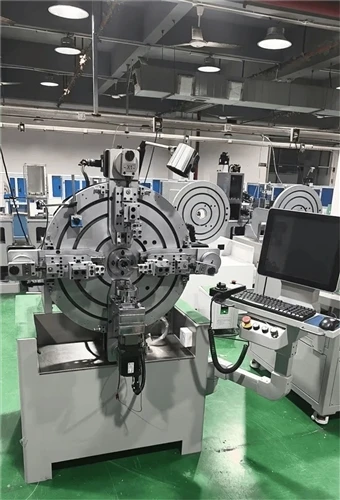
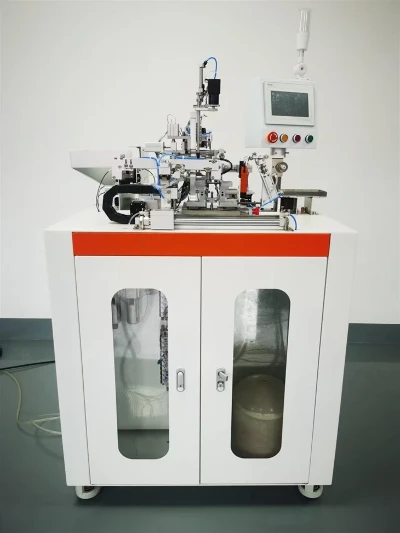
KIOXIA Light Ring Equipment Group builds winding platforms designed to handle the tension control and forming precision that edgewise and flat wire winding require, helping manufacturers avoid the buckling and inconsistency risks that come with using round-wire-oriented equipment for flat wire production.
For manufacturers scaling up high-power transformer or inductor production where skin effect and current density make flat wire the better engineering choice, working with an experienced coil winding machine manufacturer on tooling suited to your specific wire dimensions is the most reliable path to consistent winding quality.
Explore the full lineup at transformercoilwindingmachine.com to find a winding solution matched to your flat wire and high-power transformer requirements.