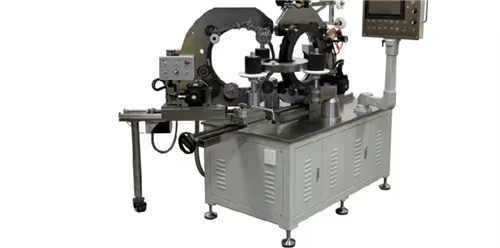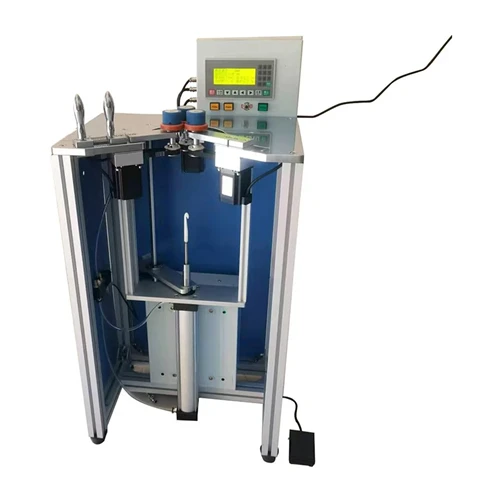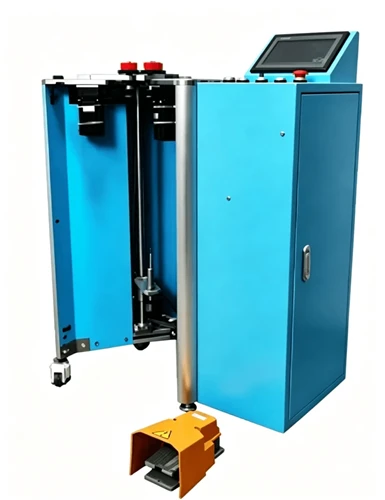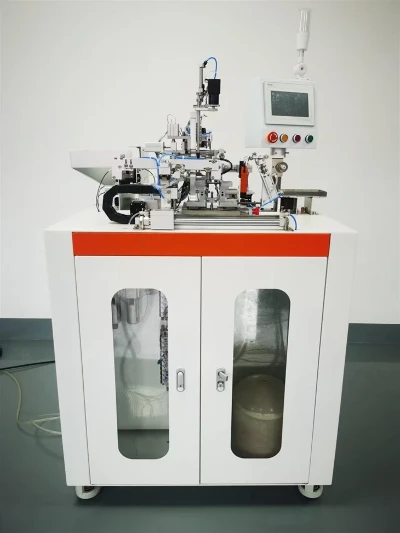


A transformer coil winding machine with a built-in coil taping machine head lets you wind the wire and apply insulation tape to the same coil in one pass, with no need to move the coil to a second station.
A double head winding and taping machine, such as the KXY-650, puts a winding head and a taping head on one platform, so it removes the transfer step, reduces handling damage, keeps tape overlap consistent and raises production efficiency for transformer, inductor and reactor coils.
If your coils need layer insulation or an outer wrap, one combined machine is usually faster and more repeatable than a winder plus a standalone automatic taping machine, provided your coil size and batch volume fit the machine. The sections below explain how it works, how much time it can save, what wire it handles, and when two separate machines are still the better choice.

I. What Is A Double Head Winding And Taping Machine?
A double head winding and taping machine is one machine with two working heads on a shared platform: a winding head that lays wire onto the bobbin or former, and a taping head that wraps insulation tape onto the coil. The operator clamps the coil once, and the machine completes both jobs in a programmed sequence.
a. The winding head
The winding head controls wire guiding, turn count, layer pitch and winding tension. It does the same job as any dedicated magnet wire winding machine, and depending on the model it can run round enamelled wire as well as flat wire.
b. The taping head
The taping head works like the head of an automatic taping machine. The tape reel moves around the coil, and the machine controls tape tension and overlap. It applies layer insulation between winding layers, margin tape, and an outer wrap at the end of the coil.
c. How it differs from standalone machines
|
Item |
Standalone winder + separate coil taping machine |
Double head winding and taping machine |
|---|---|---|
|
Number of machines |
Two |
One |
|
Coil handling |
Coil is moved between stations |
Coil stays on the same machine |
|
Operators |
Usually one per station |
Usually one |
|
Floor space |
Two footprints |
One footprint |
|
Damage risk during transfer |
Higher (wire ends, coil shape) |
Lower |
|
Cycle time |
Winding + transfer + taping |
Winding + taping, no transfer |
|
Programs and setups |
Two |
One |
|
Flexibility for taping-only jobs |
High |
Depends on the model |
II. Why Do Customers Want Winding And Taping In One Machine?
a. The problem with buying two separate machines
Many buyers start by asking for a winding machine, then realize their coils also need insulation tape between layers or around the outside, so they start pricing a standalone coil taping machine as well. Two purchases mean two machines, two sets of fixtures, two programs and a transfer step in between. That transfer step is where fine wire ends get pulled, wound coils get deformed, and tape overlap starts to vary from operator to operator.
b. A typical customer scenario
A typical inquiry we receive comes from a transformer and inductor manufacturer that already runs a separate winder and a manual or semi-automatic taping station. Operators wind a coil, carry it to the taping station, re-clamp it, tape it, and carry it on to the next process.
Output is limited by the slower station and by the waiting time between the two, and the insulation thickness changes from coil to coil because tape overlap depends on the operator. The buyer's request is simple: they do not want to buy a winder and a taping machine separately, and they ask whether one machine can do both.
For this kind of product, we recommend our double head machine, the KXY-650. The coil is clamped once, wound, and taped on the same machine, so the buyer pays for one machine, trains one operator, and manages one program.
Need winding and taping on one machine? Send KIOXIA your coil drawing, wire size and tape width, and our engineers will confirm whether the KXY-600WT fits your product. Contact us today.
III. How Much Can One Pass Improve Production Efficiency?
Production efficiency improves when non-value-adding time, such as unclamping, carrying and re-clamping, is removed from the cycle. The cycle time and output formulas below let you estimate the gain for your own coils.
a. The cycle time formula
Separate machines: T_sep = T_wind + T_transfer + T_tape
One pass: T_one = T_wind + T_tape,net
Time saving (%): S = (T_sep - T_one) / T_sep x 100
Output per shift: Q = (H x 60 x eta) / T_cycle
Here T_tape,net is the taping time that is not overlapped with winding, H is the hours per shift, and eta is machine utilization (0 to 1).
b. A worked example
The figures below are illustrative, not machine specifications. Assume a standalone process with T_wind = 8.0 min, T_transfer = 1.5 min (unclamp, carry, re-clamp, align) and T_tape = 6.0 min. On the combined machine, layer taping is programmed into the winding cycle, so T_tape,net = 3.0 min.
T_sep = 8.0 + 1.5 + 6.0 = 15.5 min
T_one = 8.0 + 3.0 = 11.0 min
S = (15.5 - 11.0) / 15.5 x 100 = about 29%
Output per 8-hour shift at eta = 0.85: available time = 8 x 60 x 0.85 = 408 min
|
Item |
Separate machines |
One pass |
|---|---|---|
|
Cycle time per coil |
15.5 min |
11.0 min |
|
Coils per 8-hour shift (eta = 0.85) |
about 26 |
about 37 |
|
Transfer steps per coil |
1 |
0 |
|
Operators needed |
1 to 2 |
1 |
|
Output gain |
Baseline |
about +42% |
c. Where the savings come from
The saving comes from three places: no transfer between stations, taping that runs inside the winding program instead of as a separate job, and fewer rejects, because a single clamping and a single program keep coil position and tape overlap consistent. Your real numbers depend on coil size, turns, layer count and tape width, so run the formula with your own cycle times.

IV. Which Wire Types And Coil Types Can A Combined Machine Handle?
A combined machine is built around the winding task first, so the wire you use decides how the winding side must be set up, and the coil design decides how the taping side is programmed. Always confirm the wire range of the specific model before ordering.
|
Wire or coil type |
What the winding side needs |
What the taping side needs |
|---|---|---|
|
Round enamelled copper wire, fine to medium |
A magnet wire winding machine with precise, stable tension |
Layer insulation between layers, outer wrap |
|
Round copper wire, heavier gauge |
A copper wire winding machine with a strong wire guide and brake |
Wider or thicker tape, sometimes more layers |
|
Flat (rectangular) wire |
A flat wire winding machine with controlled guide angle and bending radius |
Tape that protects sharp edges and corners |
|
Inductor coils |
An inductor coil winding machine with accurate turn count and layer pitch |
Narrow tape, light outer wrap |
|
Transformer coils |
A transformer coil winding machine with layer winding and margin control |
Layer insulation, margin tape, outer wrap |
a. Round magnet wire
Round enamelled wire is the most common case. The main risks are enamel scratches and wire breakage, both of which are tension problems, so the machine needs stable winding tension control from the first turn to the last.
b. Flat wire
Flat wire has sharper corners and a higher bending stiffness, so the guide angle and the bending radius matter. Taping is often more important on flat wire coils, because tape protects edges and keeps layers apart.
c. Inductor and transformer coils
Inductor coils are small and demand accurate turn counts, while transformer coils are larger and need clean layer insulation and margins. The same one-pass approach works for both, but the taping program is different for each.
V. How Do Winding Tension Control And Tape Overlap Affect Coil Quality?
Two settings decide most of the quality in a one-pass process: wire tension and tape overlap. Tension that is too high stretches or scratches the wire, and tension that is too low leaves loose turns. Tape overlap that is too low leaves thin spots in the insulation.
a. Winding tension control
A common starting point is to set tension as a fraction of the wire's breaking load:
F_set = k_t x sigma_b x A, A = pi x d^2 / 4
where k_t is typically about 0.05 to 0.15 for enamelled copper wire, sigma_b is the tensile strength of the wire, d is the wire diameter, and A is the conductor cross-section. Example: for a 0.5 mm copper wire with sigma_b of about 220 N/mm2, A = 0.196 mm2, so the breaking load is about 43 N. With k_t = 0.10, F_set is about 4.3 N. Treat this as a trial starting point and adjust after a test coil, because enamel type, wire temper and winding speed all change the best value.
b. Tape overlap and insulation thickness
Tape advance per revolution and the number of tape layers at any point follow from the tape width and the overlap ratio:
Pitch: p = W x (1 - k)
Layers: n = 1 / (1 - k)
Thickness: t_ins = n x t_tape x (number of passes)
Here W is the tape width, k is the overlap ratio (0.5 for half-lap), and t_tape is the tape thickness including adhesive. Example: with a 20 mm tape and k = 0.5, the pitch is 10 mm, so a 100 mm wide layer needs 10 revolutions of the taping head. With a 0.06 mm tape, each point is covered by n = 2 layers, giving t_ins = 0.12 mm per pass.
c. Keeping both stable in one pass
On a combined machine the winding program and the taping program share one controller and one clamped coil, so tension and overlap do not drift between operators or shifts. That repeatability is often a bigger benefit than the raw speed gain.
VI. Which Standards And Tape Materials Should You Check?
a. Industry standards
Before you fix the coil design, check the standards your customers refer to. IEC 60085 defines thermal classes for electrical insulation (for example Class B 130 °C, Class F 155 °C, Class H 180 °C). The IEC 60317 series covers specifications for particular types of winding wires, and NEMA MW 1000 covers magnet wire. Choosing tape and wire in the same thermal class avoids a weak link in the insulation system.
b. Tape materials
|
Tape |
Typical thermal class |
Typical use |
|---|---|---|
|
Polyester (PET) film tape |
About Class B (130 °C) to Class F (155 °C), depending on adhesive |
General layer and outer insulation |
|
Polyimide film tape |
Class H (180 °C) and above |
High-temperature coils, compact inductors |
|
Aramid paper tape |
Up to about 220 °C |
High-temperature transformer coils |
The ratings above are typical values. Always confirm thermal class, thickness and breakdown voltage on the tape supplier's datasheet.

VII. How Do You Decide Whether A Double Head Machine Is Right For You?
a. When one machine is the better choice
Most of your coils need both winding and taping.
You run repeat orders or medium to large batches, where removing the transfer step adds up.
You want one operator, one program and one footprint.
Consistent tape overlap matters to your customers' insulation requirements.
b. When separate machines still make sense
Your coils are very large or very heavy and need dedicated handling.
You run many taping-only or winding-only jobs, so one head would sit idle.
Your process places a curing or inspection step between winding and taping.
If you are not sure which group you fall into, send us your coil drawings and monthly volume, and we will tell you honestly whether a combined machine or two separate machines suits you better.
VIII. Which KIOXIA Machine Should You Choose?
If your coils need both winding and taping, we recommend the KIOXIA double head machine KXY-600WT, which winds and tapes on one platform in one pass, so you buy one machine instead of two, save the transfer step, and get more consistent insulation.
KIOXIA Light Ring Equipment Group, based in Tianjin, also builds transformer coil winding machines for toroidal, air coil and other coil types, so we can match a machine to your wire, coil and output. Visit transformercoilwindingmachine.com or contact our engineers with your coil drawing and we will recommend the right configuration.
You may be interested in:
Why Are High-Power Transformers More Likely To Use Flat Copper Wire Instead Of Round Copper Wire?
Toroidal Transformer Failure: Causes & Prevention
Key Machinery Required To Build A Semi-Automated Transformer Factory From Scratch
Servo Motor Toroidal Winding Machine: Why Closed-Loop Tension Matters For Fine Wire